Back to All Guides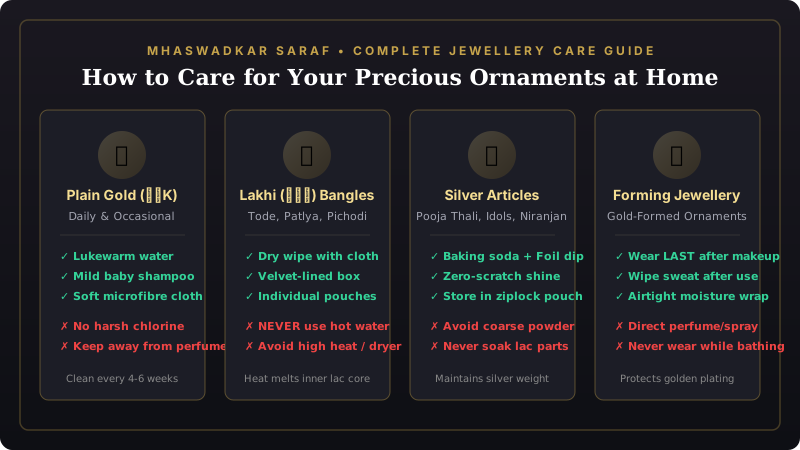
Jewellery Care
7 min read
The Complete Jewellery Care Guide: Gold, Lakhi, Silver Utensils & Forming Jewellery
Practical, step-by-step guidance tailored for Indian climates and household conditions to preserve the luster and structural integrity of your precious ornaments.
Listen
0:00
Loading audio...
TABLE OF CONTENTS
1. The Indian Climate Challenge: Sweat, Turmeric & Chemicals2. Caring for Gold Jewellery (22K, 18K & 14K)3. Lakhi Jewellery Care: Traditional Tode, Patlya & Bangles4. Silver Utensils & Pooja Articles (चांदीची भांडी व पूजा साहित्य)5. Silver Jewellery Care (Payal, Bichiya & Kade)6. Forming & Gold-Plated Jewellery (फॉर्मिंग व १ ग्रॅम गोल्ड दागिने)7. Diamonds & Precious Gemstones: Retaining Brilliant Fire8. Pearls, Polki, Kundan & Jadau: Organic & Foil-Backed Care9. Enamel (Meenakari) Care & Smart Jewellery Storage? Frequently Asked Questions
1. The Indian Climate Challenge: Sweat, Turmeric & Chemicals
In Indian households, precious ornaments are exposed to unique environmental factors: tropical humidity, perspiration, cosmetic perfumes, hairsprays, and everyday rituals involving turmeric (haldi) and vermilion (kumkum). Turmeric is a natural dye that can discolour gemstones and white gold, while alcohol-based perfumes erode delicate rhodium platings and pearl nacres. Always apply cosmetics and perfumes first, allow them to dry completely, and put your jewellery on as the final touch before stepping out.
Golden Rule: Last On, First Off
Put your jewellery on last after makeup, perfume, and lotion have completely dried. When returning home, remove your ornaments first before bathing or household chores.
2. Caring for Gold Jewellery (22K, 18K & 14K)
Pure 22 Karat (916) jewellery is naturally malleable and requires gentle handling. Over time, body oils, lotions, and dust accumulate in intricate settings and clasps. To clean at home: soak pieces for 10 minutes in a small bowl of lukewarm water mixed with a few drops of baby shampoo. Use an extra-soft baby toothbrush to gently dislodge trapped dirt behind settings. Rinse under running lukewarm water in a closed-drain basin, and pat dry thoroughly with a clean microfiber lint-free cloth. Store each piece in individual velvet-lined compartments to prevent chain links from tangling or scratching.
3. Lakhi Jewellery Care: Traditional Tode, Patlya & Bangles
Lakhi jewellery (लाखी दागिने) is a celebrated Maharashtrian heritage craft, where hollow embossed gold casings are filled with natural lac resin to provide sturdy form and prevent dents. Because lac softens at high temperatures, lakhi ornaments must NEVER be exposed to hot water, blow dryers, steam baths, or locked inside hot cars during peak summer. Never submerge lakhi bangles in water; if damp, wipe them immediately with a soft cotton cloth. Do not press tightly on the embossed motifs when putting them on or taking them off.
Never Expose Lakhi Ornaments to Heat
Heating lakhi bangles can cause the resin to expand and leak through microscopic joints, irreversibly damaging the artistic gold embossing.
4. Silver Utensils & Pooja Articles (चांदीची भांडी व पूजा साहित्य)
Silver items in Indian pooja rooms—such as niranjan, tamhan, kalash, and murtis—tarnish when exposed to air and pooja smoke. Traditional abrasive powders like brick dust or rough cleaning powders physically scrape off fine layers of silver over time, reducing their actual weight. Instead, use the safe electrochemical dip method: line a glass or plastic vessel with ordinary aluminum foil (shiny side up). Add 2 tablespoons of baking soda and 1 tablespoon of salt, then pour boiling hot water. Submerge the silver articles ensuring they touch the foil. Within 3 minutes, the sulfur transfers electrically to the aluminum, restoring original silver shine with ZERO loss of metal weight! Rinse and dry.
Electrochemical Restoration: Zero Weight Loss
Chemical reaction: 3 Ag2S + 2 Al -> 6 Ag + Al2S3. The tarnish reverses back into pure silver while sulfur bonds to the sacrificial aluminum foil. No metal is scraped away.
5. Silver Jewellery Care (Payal, Bichiya & Kade)
Anklets (payal) and toe rings (bichiya) are subjected to continuous friction, sweat, and soap residue. Dirt accumulates in the tiny links and decorative bells (ghungroos). Clean every fortnight using mild soapy water and a soft-bristled brush to remove accumulated grime. Always dry completely before wearing. Store unworn silver jewellery in airtight zip-lock bags with a small food-grade silica gel sachet to absorb moisture.
6. Forming & Gold-Plated Jewellery (फॉर्मिंग व १ ग्रॅम गोल्ड दागिने)
Forming jewellery features micro-electroplated layers of gold over copper or brass bases. Perspiration, deodorants, water, and chlorinated pool water will strip this delicate gold film. Never spray perfumes near forming necklaces. After every wear, gently wipe sweat away using a dry, soft cotton cloth. Never store forming ornaments in raw cotton wool, as processed cotton often contains bleaching chemicals and moisture that cause rapid tarnishing. Keep each piece in its own zip pouch.
7. Diamonds & Precious Gemstones: Retaining Brilliant Fire
Diamonds are natural magnets for grease, skin lotions, and cooking oils, which form a film behind the pavilion and diminish their signature brilliance. Clean diamonds by soaking in warm water with gentle liquid soap for 10 minutes. Gently brush the top and underside with a soft-bristled baby toothbrush, rinse thoroughly in warm water, and pat dry with a lint-free cloth.
Important: Colored gemstones like Emeralds (पाचू/Panna) and Rubies have natural microscopic inclusions. Never subject emeralds to hot water, steam, or ultrasonic cleaners, as sudden thermal shocks can fracture the stone. Have gemstone prongs inspected annually to ensure stones remain tightly secured.
Keep Away from Chlorine & Swimming Pools
Chlorine in tap water and swimming pools attacks the alloy metals in 18K and 14K gold, causing stress corrosion cracking around gemstone prongs.
8. Pearls, Polki, Kundan & Jadau: Organic & Foil-Backed Care
Pearls are organic gems with delicate calcium nacre. Acidic sweat, perfumes, and hairsprays permanently dissolve this outer luster. NEVER submerge a pearl necklace in water—moisture weakens the silk thread core and traps dirt between beads. Wipe pearls with a soft, slightly damp chamois cloth after wearing, and restring every 1-2 years.
Kundan and Polki (Jadau) ornaments require even greater caution. In authentic Jadau work, uncut diamonds are mounted over reflective silver foil (daak) sealed with 24K gold foil. If water or moisture seeps into the setting, the silver foil turns black, permanently darkening the stones. Never wash Kundan jewellery in water; keep it strictly dry in airtight boxes with velvet cushions.
Strict Moisture Prohibition on Kundan & Polki
Once moisture blackens the inner silver foil of Kundan or Jadau ornaments, it cannot be cleaned at home and requires complete resetting by traditional karigars.
9. Enamel (Meenakari) Care & Smart Jewellery Storage
Enamel (मीनाकारी) is delicate coloured glass fused to precious metals at high heat. While vibrant, enamel can chip or shatter if dropped on marble floors or subjected to sharp impacts. Wipe enamel with a dry, lint-free microfiber cloth. Never boil or expose to abrasive cleaners.
Best Storage Practices for Indian Homes:
• Store each piece individually in velvet or suede-lined boxes, or separate soft pouches.
• Fasten clasps before storing to prevent necklaces and chains from tangling into knots.
• Place food-grade silica gel packets inside your locker or vanity case to combat monsoon humidity.
• Never store jewellery in ordinary bleached cotton wool or plastic ziplocks containing sulfur.
Frequently Asked Questions
PUBLISHED BY
Mhaswadkar Saraf Private Limited
CIN: U74900PN2012PTC143175 • BIS Gold: HM/C-3879591 • BIS Silver: HM/C-7590180626
About Our Heritage
RELATED ADVISORY GUIDES
Check Today's Live Market Benchmark Rates
Daily benchmark rates updated directly from our showroom billing systems.
View Live Rates Board